|
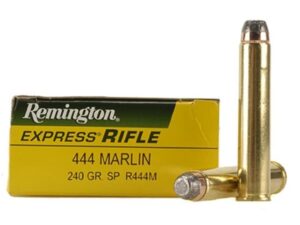
The .444 Marlin was introduced in 1964 and at the
time was the only big bore, lever action rifle on the market. The Winchester big bores
were long gone and the .45-70 was still several years from being
introduced by Marlin. Shooters brought up on the .30-30 and .35 Remington lever
guns embraced this new big bore chambering. As a deep woods gun, it had plenty of
punch and was capable of taking down anything the average hunter was after.
After the .45-70 was chambered in the Marlins a few
years later, it became much more popular. But the .444 continued along. The
advantage of the .45-70 was it's caliber, which allowed it to use heavy .458
rifle bullets designed for other rifles. The .444 was designed to use .429
caliber bullets designed for pistol use. Once people started hand
loading the .45-70 to the pressures capable of being used in the Marlin rifles,
some very impressive ballistics were produced. Over the years there has been a
lot of hype about the hot loaded .45-70 being good for any game on earth,
including African big game. Along those lines there has been additional hype
about how the .45-70 is a better penetrator in dangerous heavy game than the
.458 Winchester magnum and the .458 Lott. Without going into a lot of detail
here, there is no argument that the .45-70 can kill an elephant or cape buffalo.
They have been killed with 7mm rifles too. But nobody claims that the 7mm Mauser
(7x57) is an adequate dangerous game caliber.
However, we have done a good deal
of penetration testing over the years and after reading all of the articles
regarding how much better the .45-70 penetrates with a 500 grain bullet at 1600
fps versus a .458 Winchester magnum at 2000 fps, we find flaws in the
methodology. Penetration requires a lack of deformation of the projectile. In
the testing people have done to prove superior penetration of the slower .45-70,
they have compared bullets ideally suited for the velocity of the .45-70 to
bullets not ideally suited and known to have performance problems at .458
velocities. The .458 bullets chosen are always run-of-the-mill, round nose, full
jacketed bullets. Never have we seen the Barnes banded solids, the now
discontinued Speer AGS solids or even the newer Hornady dangerous game solids
used in these tests.
In any case, the end result has been that the .45-70
has been hyped into being the "only logical choice" for a big bore lever gun. We
decided to see what the classic .444 could do and if it was the real world equal
of the .45-70.
Marlin .444 rifles built up until 1997 used what is
called Microgroove rifling. Unlike conventional rifling, the Microgroove process
creates more lands and grooves but at a much shallower depth. Marlin patented
this process in the 1950's as a way to speed the rifling process and produce
smooth and uniform barrels. Marlins specifications for the .444 were for 12
grooves that were .0045" deep. The factory barrels were set to a nominal
diameter of .433 inches. The twist rate for these Microgroove barrels was set to
1 in 38 inches. This twist rate was designed for the 240 grain pistol bullets
originally envisioned as being the ideal load for this cartridge.
The 240 grain bullet was the standard bullet in the
.44 Magnum in those days and therefore it was deemed good enough for the .444.
However, over the years, people started to realize that the 300 grain bullets,
especially hard cast lead ones, were a better choice for the .44 Magnum for big
game. Remington started loading a 265 grain bullet for the .444 and Hornady
began selling a 265 grain bullet to reloaders. The bullets were kept at this
weight range because of the worry that the 1 in 38 twist of the marlin .444
barrel would not stabilize a heavier bullet. The reality was that for big game
even up to moose, the 265 grain bullet worked and worked well. Given the .45-70's
greater popularity, not a lot of work was done to go any further with .444
factory loads or bullets.
As time went on the bullets that meant high
performance in these big bores didn't come from the typical factories in the
form of jacketed bullets but came from small outfits filling a niche for heavy
and very hard cast bullets. These hard cast heavy bullets became popular in not
only handguns like the .44 magnum but in rifles like the .45.70. As reports of
their excellent performance on game increased it became clear that these were
the bullets of choice in big bore guns.
Heavy hard cast bullets
became available for the .444 allowing it to take advantage of it's power and
make it a true big game choice. However, one small issue got in the way of this progress. The
specifications for the Marlin barrel cited above called for a nominal .433
grove diameter. With deep conventional rifling this would not have been a major
factor. However, with the shallow Microgroove rifling, putting lead bullets sized
to .429 or .430 down a .432-.433 bore resulted in terrible accuracy. the word
went out that the Marlin barrel in the .444 couldn't shoot heavy lead bullets.
However, looking at the situation with a technical eye clearly showed the
solution to this problem. Instead of using cast bullets at .429 use bullets at
.432 diameter. These would fill the barrel and allow the shallow rifling to
properly grab the bullet and stabilize it.
Once the sizing issue was resolved it also became
apparent that the Microgroove 1 in 38 barrels could also shoot bullets up to 330
grains with excellent accuracy. The other part of the equation for accuracy was
to use maximum loads at maximum pressure and high velocity. Properly sized
bullets that were of mediocre accuracy at lower pressures suddenly became quite
accurate when put out at maximum velocity. These 300-330 grain bullets brought
the .444 marlin into the realm of the .45-70 and made it a real choice as a big
game rifle or bear gun. Although neither of these calibers are considered
adequate for African game they can easily take down any North American game
quickly and cleanly.
This evolution of the .444 cartridge brought us to
this place, where we take a 1970's vintage stock .444 Marlin and turn it into a
compact and potent big game or bear gun. The original gun was a used
(but in
excellent condition) 70's gun with a 22 inch barrel. We decided to turn it into a
carbine style gun with a couple of added extras for reliability and speed.
The first thing that needed changing was the barrel
length. The 22 inch barrel was way too long for the intended purpose of this
gun. Marlin now offers an 18 1/2 inch version of this gun but we decided to go
all the way to the minimum of 16 inches. While we have cut and crowned many
barrels before we decided this time around to take it to a professional and let
him deal with the metal work. Part of the decision here was based on the fact
the newly cut barrel would have to be drilled and tapped to reinstall the front
sights. While not beyond doing this ourselves it was simply easier to just get
it done. We also wanted to put this gun together like the average reader would
who doesn't have access to the equipment or doesn't want to do their own metal
work. After a day at the gunsmith and a $100 cost we walked away with a
beautiful 16 1/4 inch barrel professionally cut and crowned with the sight holes
drilled and tapped.
On our list of changes and
improvements was to
replace the factory sights with fast peep sights. These sights are fast to
acquire the target and can be easily used with both eyes open, a big advantage
in a situation where you are the prey and the animal is headed your way. We've
used the excellent Williams peep sights on several Marlins and Winchesters in
the past. But for this project decided to try out the sights offered by XO
Systems. They are much smaller than the Williams sights and made of steel. The
one drawback is that the adjustments on them are cumbersome to set. However, for
a rifle like this we're not worried about being able to adjust the sights
constantly. We're more worried that once we get the rifle sighted in with our
load that it keeps its' setting day in and day out. After installing the XO
sights and sighting them in, we were quite pleased with their performance. After
several months of handling the gun, the zero has not moved and we are quite
confident that they will do their job in the field.
As a side note... there has been much discussion about the Marlin
ejector over the years. Many people believe it is a weak link and prone to break
at the worst possible moment. Although we've never experienced a broken Marlin
ejector we decided to replace it with an aftermarket piece produced by Wild West
Guns. They appropriately call it the bear proof ejector.
Our logic here was that
we were working with a nearly 40 year old gun with the original ejector. So
given the talk about Marlin ejectors failing it made sense to replace it with a
new one just to be safe. After all we're building a gun that could be used for
self defense. It only makes sense to do everything possible to ensure
reliability. At first we were thinking of just getting a new Marlin ejector. The
cost of this part was about $11. This is a two piece part and the Wild West
product is a one piece replacement. Part of the claim for the reliability of
this ejector is the one piece design. The Wild West ejector was $25 and we
decided the difference in price was small enough to buy whatever additional
reliability the one piece part might offer. The ejector was very well made and
very smooth. It popped right in place and worked perfectly with no fitting. The
gun cycled very smoothly afterwards with no obvious drag from the new part. We
were quite pleased with the quality of the ejector from a manufacturing
tolerance standpoint.
Our final enhancement had to do with shooting
comfort. Although the .444 with standard factory ammunition is a stout kicker
when loaded with 330 grain bullets at maximum velocity, it packs a nice punch on
both ends. We picked up a Limbsaver recoil pad, removed the original and
screwed the Limbsaver on. The fit was also perfect with no adjustments required.
While the new 18 1/2 inch Marlins come with a factory ported barrel, we decided
against this option. The increase in the noise of these ported barrels to the
shooter and those around him makes it undesirable for us. These are not target
guns that you will likely be hanging around the range shooting all day log.
These are working guns that will be carried a lot and shot little. So the
advantage of the porting really isn't a factor.
We've tested a lot of bullets in the .444. For
standard, factory-style, copper jacketed offerings we like the Swift A-Frame 280
grain bullet. Although it's a hollow point designed for the .44 magnum it works
very well in the .444 -- due to it's partition construction and bonded core. We've
shot this through various test media at 2000 feet per second and it has always
held up and retained 85 or more percent of it's weight. If you don't like or
can't get hard cast lead bullets of the proper diameter then this is the top
choice in the .444 marlin. The big downside to these premium bullets is the
premium price. Not an issue for hunting or self protection but not a bullet to
be used for practice or target shooting.
We also had good success with the Sierra 250 grain
FPJ bullet. This bullet has a fairly thick and rigid copper jacket that rolls
over the small exposed lead tip. It is designated as a non expanding bullet but
at these velocities the nose will expand to full diameter or more. Although too
light for large game it is a better choice at .444 marlin velocities than the
standard 240 grain pistol bullets. Unlike the standard pistol bullets it will
penetrate deeply and get the job done. It is also fairly inexpensive making it a
good all around jacketed choice.
We tested the original heavy bullet for the .444,
the Hornady 265 grain interlock bullet as well as the 270 grain Speer Gold Dot.
The Hornady has taken a lot of deer and medium sized game over the years and
still performs reasonably well. In addition, the bullets maintain a reasonable
amount of weight after hitting the test medium. For deer size game it's a good
bullet and has the advantage of being priced reasonably. If you are only looking
for a deer gun and are not concerned with larger game it is a excellent choice
that will work. The Speer expanded more then the Hornady, maintaining slightly
more weight due to it's bonded construction. The Hornady out penetrated the
Speer in all of our test cases. However we also had an instance of the Speer
breaking up when hitting hard bone like test media at maximum velocity. For deer
size game this would not be an issue. It's not a bullet for larger game and was
designed with the .44 Magnum in mind and is excellent in that application. For
the price the Hornady is the better choice in this weight class.
Although they shot well, none of the jacketed 300
grain pistol bullets were up to the intensity of the .444 cartridge. At short
ranges they would over expand or even disintegrate in test media. While they are
OK for deer size game they should not be used for large or dangerous game. They
will over expand and not penetrate well on large animals. Even for deer we find
the overexpansion of these bullets, which are designed for pistol velocities, to
be excessive and will destroy a lot of meat in the process.
However, our favorite and now standardized bullet in
the .444 Marlin is the Beartooth bullets 330 grain LFNGCDCG hard cast bullet.
Beartooth will custom-size bullets to your needs. Although delivery is slow
due to the hand made nature of the product, the quality is excellent. Beartooth
also offers an excellent fire lapping kit for smoothing out barrels. It can make
a big difference in accuracy and cleaning. Due to the age of our test rifle and
the fact hat it has had a pretty good number of rounds through the barrel we
decided not to fire lap. However, we will review this kit in a future article.
Out of the 16 1/4 inch barrel, this bullet will achieve over 2000 feet per
second and deliver 2930+ foot pounds of energy. The recoil of this load on your
shoulder is on the order of 33 pounds. This is a deeply penetrating, powerful
load that will stop any North American game with power to spare. This bullet
penetrated better than all of the other bullets tested. We've had this bullet go
through both shoulders of a moose and exit, providing an instant dropping of the
animal.
The two top powders we have found for loading the
.444 in our test gun were H322 and H4198. In our guns they both gave top
velocities and excellent accuracy. While H322 has been a powder of choice for a
long time in the .444 we decided to go with the 4198 due to it's modern
temperature insensitive formulation. Other powders that gave good results and
are worth trying when determining the best load for your gun are H335, AA2015
and Reloader 7.
Comparing to the hottest of the .45-70 loadings with
a 500 grain bullet at 1650 feet per second yields 3020 foot pounds of energy
with a recoil force of 47 foot pounds. Although the .45-70 can deliver a heavier
bullet the actual energy is about the same. However, the difference in recoil is
quite significant and could easily affect follow up shots. Granted a ported
.45-70 barrel would minimize this but we're comparing non ported guns for the
purpose of this discussion. Our contention is that no game animal is going to be
able to tell the difference between a .432 inch bullet completely penetrating it
and a .458 inch bullet doing the same thing.
The bottom line is that the .444 Marlin has finally
become all it can be and it is a mighty fine and balanced cartridge for the big
game hunter or someone looking for bear protection.
|